

A basic diagram of an individual NEURON
The nervous system is a system of neurons, the nervous cells. A neuron consists of three parts: the body (soma), dendrites and axon. Dendrites and axon are filaments that extrude from the soma - typically multiple dendrites but always a single axon. The function of dendrites (and soma) is to receive signals from other neurons, while the function of the axon is to transmit signals further.
Where the axon of one neuron approaches a dendrite or soma of another neuron, a synapse is formed. This means that a synapse ( or a synaptic gap) is a structure that connects two neurons. Each neuron on average has about 15,000 connections with other neurons, so it is a very elaborate network.
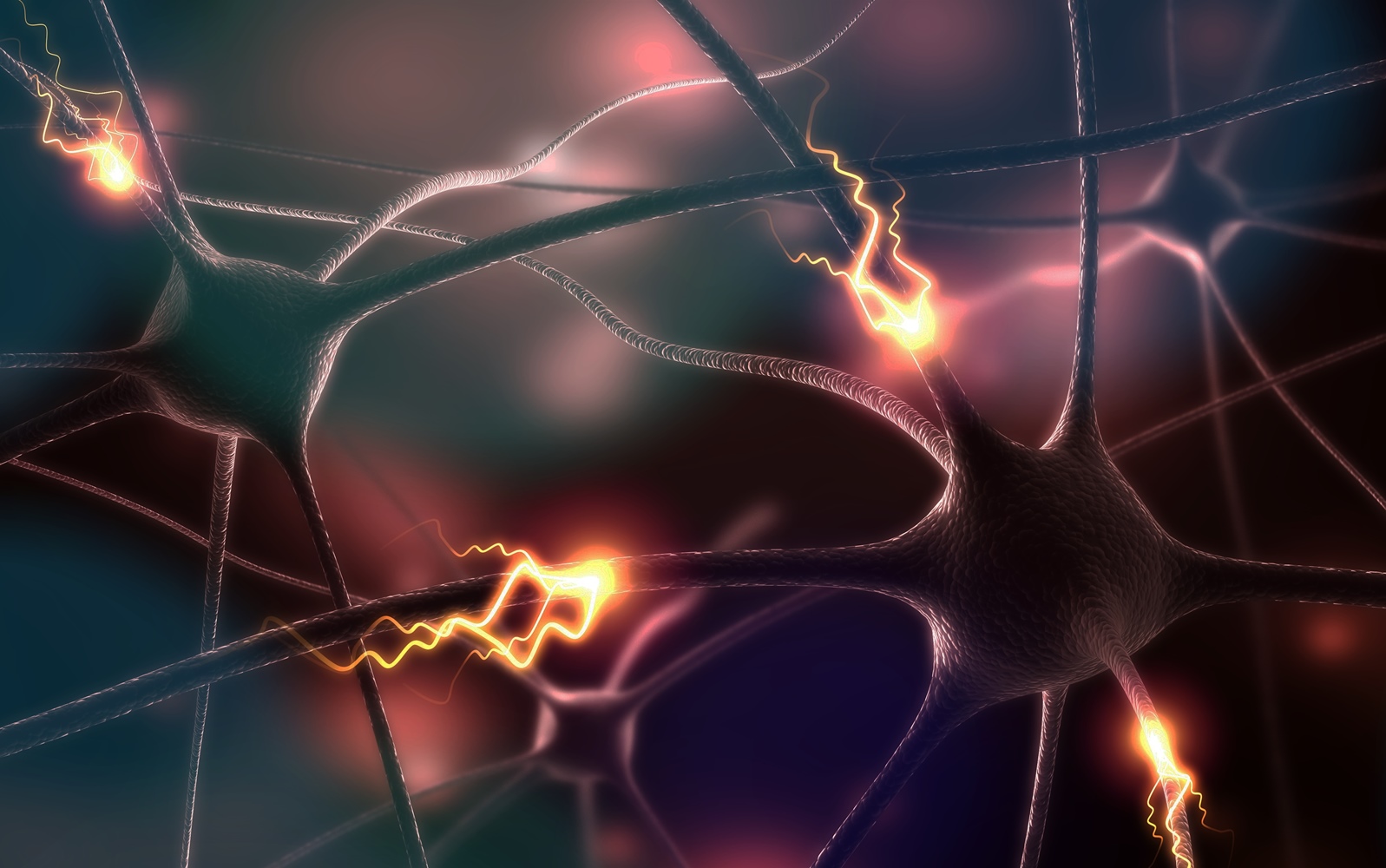
The nature of information transmission in the nervous system is partly electrical and partly chemical. Every neuron has a certain threshold of excitation received from the other neurons. If the sum excitation exceeds this threshold the neuron "fires" - generates a brief pulse called action potential that travels along the axon to other neurons, passing the excitation further. The sum excitation is either on or off (1 or 0).
Axon terminal and synaptic gap

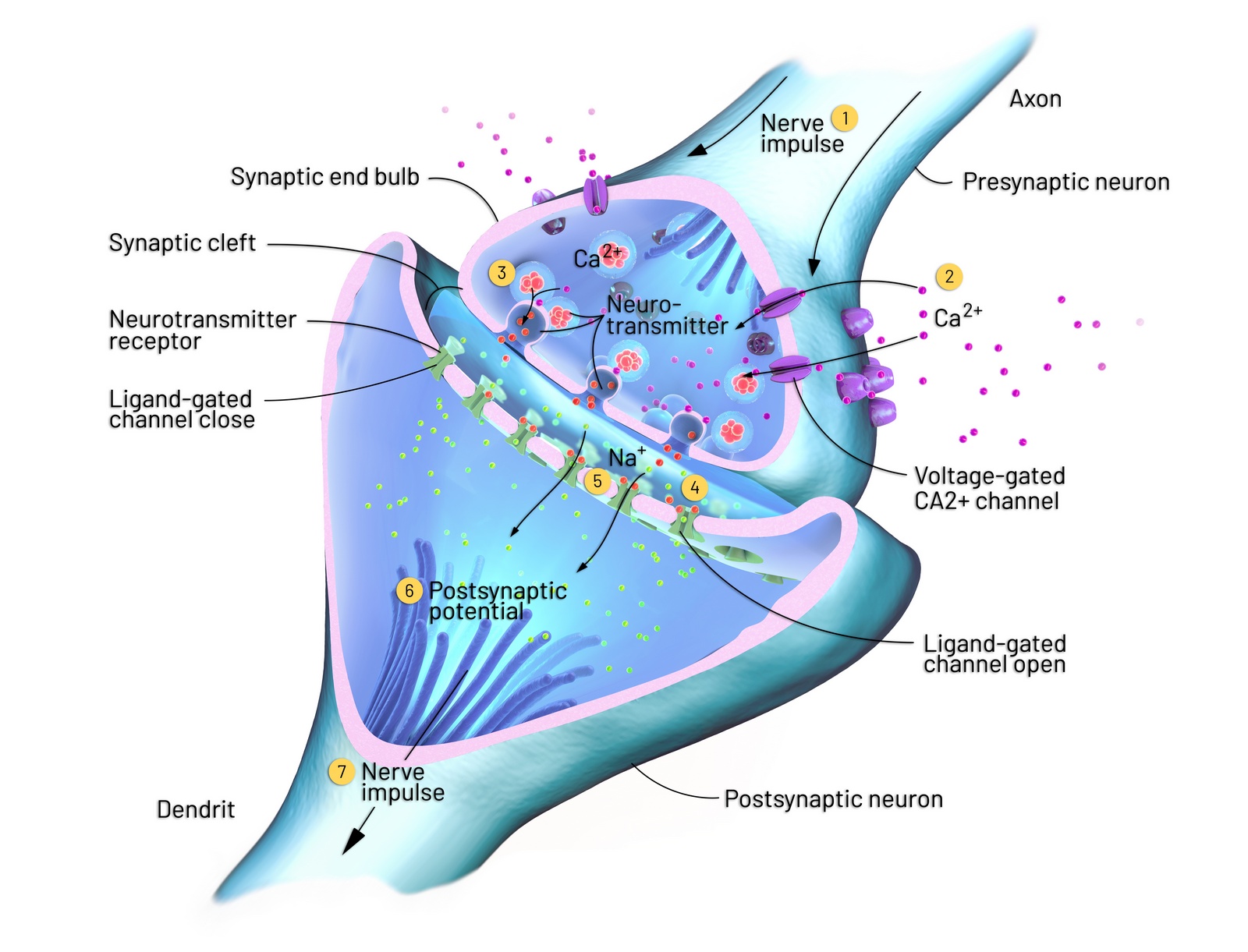
A basic diagram of the synapse and synaptic gap
Neurotransmitters firing and moving cross the synaptic gap
The pulse reaches the end of the
axon and there, at the synaptic gap, the mechanism of transmission becomes
chemical.
When the action potential reaches
the end of
the axon, a neurotransmitter is
released from the axon terminal into the synaptic gap.
Neurotransmitters are chemical
messengers. They are constantly synthesized in the neuron and moved to the axon
terminal to be stored there. A released neurotransmitter is available in the
synaptic gap for a short period during which it may be destroyed (metabolized),
pulled back into the pre-synaptic axon terminal (reuptake), or reach the post
synaptic membrane.
If the neurotransmitter binds to
a receptor in the post-synaptic membrane, this process changes the membrane
potential and so contributes to activating an electric pulse in the
post-synaptic neuron. Here the chemical mechanism becomes electrical again.
There are many different
neurotransmitters. Their exact number is unknown but more than 100 have been
identified. All neurotransmitters are broadly divided into two groups:
excitatory and inhibitory.
Inhibitory neurotransmitters stop
the impulse, preventing it from crossing the synapse. They produce calming
effects on the brain. These neurotransmitters are always in a state of dynamic
balance. When excitatory or inhibitory neurotransmitters are out of their
optimal ranges in the brain, this may cause various behavioural
malfunctions such as mental disorders.
Neurotransmitters themselves are
affected by agonists and antagonists. Agonists are chemicals that enhance the
action of a neurotransmitter. Antagonists are chemicals that counteract a
neurotransmitter and so prevent a signal from being passed further.
Many drugs function as agonists
or antagonists. For example, a class of drugs known as SSRIs (selective
serotonin reuptake inhibitors) selectively inhibit (block) the reuptake of the
neurotransmitter serotonin from the synaptic gap. This increases the concentration
of serotonin in the synapse. SSRis
have been shown to be effective against depression.
We must always be cautious about reductionism. Human behaviour is rarely, if ever, that simple.
Imagine we have artificially
increased the level of neurotransmitter X in the brain
and this resulted in a change of behaviour
Z (for example, elevated mood). Can we say
that neurotransmitter X
influences elevated mood?
Yes, to a certain extent, but
with a lot of limitations to be kept in mind.
X
may function as an agonist for neurotransmitter Y, which in tum may affect behaviour
Z. In other words, the effects of neurotransmitters may be indirect, sometimes
with many links between the "cause" and the "effect".
X
may serve as a trigger for a long-lasting process of change in a system of
interconnected variables. In other words, the effects of X on Z may be
postponed.
X
is usually not the only factor affecting Z. X
is never the only factor that changes. As you artificially increase the level
of X, this may result in various side effects.
Research into the influence of
neurotransmission on behaviour
will therefore always be reductionist in the sense that we need to manipulate
one variable (X) and assume that it is the only variable that changes.